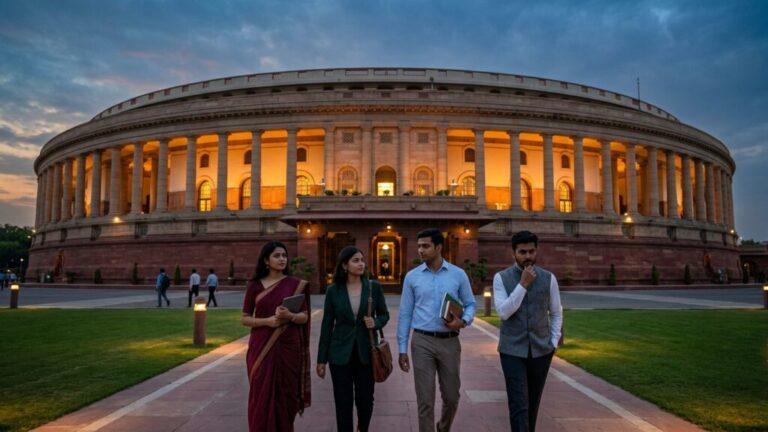
Understanding India’s Democratic Pillars: Parliament, Constitution, and Recent Legislative Challenges
India, the world’s largest democracy, stands firm on the robust foundations of its Parliament and Constitution. These two pillars are instrumental in shaping the nation’s governance, ensuring representation, and upholding democratic principles. Recent legislative efforts in April 2026, particularly concerning the Women’s Reservation and Delimitation Bills, brought these foundational roles into sharp focus, highlighting the intricate interplay of constitutional mandates and parliamentary dynamics.
The Indian Parliament: A Pillar of Democracy
The Indian Parliament is the supreme legislative body of the country, embodying democratic principles and responsible for shaping national policies. For aspirants preparing for government jobs, understanding its structure and functions is crucial.
Bicameral Legislature
The Parliament is bicameral, consisting of the President, the Rajya Sabha (Council of States), and the Lok Sabha (House of the People).
- Lok Sabha (House of the People): Members are directly elected by the people through universal adult franchise. The maximum strength is currently capped at 550 members (up to 530 from states and 20 from Union Territories). Eligibility criteria include being a citizen of India, at least 25 years old, and possessing other qualifications prescribed by Parliament.
- Rajya Sabha (Council of States): Members are elected by the elected members of the State Legislative Assemblies. It can have a maximum of 250 members. Eligibility criteria include being a citizen of India, at least 30 years old, and possessing other qualifications prescribed by Parliament.
- President: An integral part of the Parliament, though not a member of either House. The President summons and prorogues the Houses and gives assent to bills for them to become law.
Key Functions
The Parliament performs multifaceted roles vital for governance:
- Law-making: It enacts laws on subjects in the Union List and Concurrent List.
- Executive Oversight: It holds the executive (Council of Ministers) accountable for its policies and actions.
- Financial Powers: It controls the nation’s finances, including the formulation and approval of the Central Budget.
- Constituent Powers (Amendment): It has the authority to amend the Constitution under Article 368.
- Judicial Powers: It can impeach the President and remove judges of the Supreme Court and High Courts, the Chief Election Commissioner, and the Comptroller and Auditor General.
- Electoral Powers: It participates in the election of the President and Vice President.
The Indian Constitution: A Guiding Document
The Indian Constitution, which came into effect on January 26, 1950, is the foundational legal document for the world’s largest democracy. It serves as the supreme law, guiding all legislative, executive, and judicial actions.
Salient Features
- Lengthiest Written Constitution: Globally recognized as the lengthiest written constitution for a sovereign nation.
- Drawn from Various Sources: It has borrowed provisions from various constitutions worldwide, reflecting a blend of global best practices.
- Blend of Rigidity and Flexibility: The amendment procedure is neither as flexible as Britain’s nor as rigid as the USA’s, allowing for adaptation while preserving core principles.
- Federal System with Unitary Bias: It establishes a federal system but with a strong central government, ensuring national unity.
- Parliamentary Form of Government: India follows a parliamentary system where the executive is responsible to the legislature.
- Fundamental Rights: It guarantees fundamental rights to its citizens, ensuring liberty and equality.
- Directive Principles of State Policy (DPSPs): These are guidelines for the state to promote the welfare of the people and establish a social and economic democracy.
- Independent Judiciary: It establishes an independent judiciary to interpret the Constitution and protect rights.
- Secular State: India is a secular state, meaning it has no official religion and treats all religions equally.
- Universal Adult Franchise: All adult citizens have the right to vote, ensuring broad political participation.
- Single Citizenship: India provides for single citizenship, fostering a sense of national identity.
Recent Legislative Developments: The Women’s Reservation and Delimitation Bills (April 2026)
Recent legislative efforts in April 2026 aimed to accelerate the implementation of women’s reservation and address delimitation, sparking significant debate and scrutiny.
Background: The Nari Shakti Vandan Adhiniyam (2023)
The Constitution (One Hundred and Sixth Amendment) Act, 2023, also known as the Nari Shakti Vandan Adhiniyam, was a landmark legislation passed in 2023. This Act provides for 33% reservation of seats for women in the Lok Sabha, State Legislative Assemblies, and the Delhi Legislative Assembly. However, its implementation was made contingent on a delimitation exercise after the first census conducted post-2026. The government formally notified the commencement of the 2023 Act in a late-night move on April 16, 2026.
The 2026 Bills and Their Objectives
On April 16, 2026, three bills were introduced in the Lok Sabha:
- Constitution (131st Amendment) Bill, 2026: This bill aimed to expand the Lok Sabha from 543 to 850 seats (815 from states and 35 from Union Territories). It also sought to accelerate the delimitation process by deleting the third provision of Article 82, which mandates delimitation after the first census post-2026. This would enable delimitation using census data available before the 2026-27 Census. Furthermore, it proposed changes to Article 334A to enable the women’s reservation framework to be implemented using the 2011 Census as the baseline, aiming to fast-track women’s political representation potentially before the 2029 General Elections.
- Delimitation Bill, 2026: Introduced on April 16, 2026, this bill provided for the constitution of a Delimitation Commission to readjust and reallocate seats in the Lok Sabha and State Legislative Assemblies. It proposed that delimitation would be based on the latest census figures published as on the date of the commission’s constitution, implying the use of the 2011 Census.
- Union Territories Laws (Amendment) Bill, 2026: This bill was intended to give effect to similar provisions for Puducherry, Delhi, and Jammu & Kashmir.
Failure in Lok Sabha
On April 17, 2026, the Constitution (131st Amendment) Bill, 2026, failed to pass in the Lok Sabha. It received 298 votes in favor and 230 opposed, falling short of the required two-thirds majority (352 votes) of members present and voting. With 528 members participating, the bill needed 352 votes but secured only 298, a shortfall of 54 votes. Following this defeat, the government also withdrew the two companion legislations: the Delimitation Bill, 2026, and the Union Territories Laws (Amendment) Bill, 2026, as they were linked to the 131st Amendment.
Reasons for the Setback
The failure of these crucial bills was attributed to several factors:
- Lack of Special Majority: Constitutional amendment bills require a special majority, meaning a majority of the total membership of the House and a majority of not less than two-thirds of the members present and voting. The bill failed to secure this constitutionally mandated two-thirds majority.
- Opposition Concerns on Delimitation Linkage: The opposition expressed strong concerns regarding the linkage of women’s reservation with delimitation. They viewed it as a “Trojan Horse” to redraw the electoral map and accused the government of attempting to manipulate constitutional provisions.
- Accusations of Redrawing Electoral Map: Opposition parties feared that delimitation based on the 2011 Census would disproportionately benefit northern states with higher population growth, potentially reducing the relative representation of southern states. Southern states, which have successfully implemented population control measures, feared losing parliamentary seats.
- Trust Deficit: A significant mistrust existed between the ruling party and the opposition, with the opposition demanding that all guarantees be explicitly written in the bill rather than relying on verbal assurances.
Implications
The immediate consequences of the bills’ failure include:
- Delay in Implementing Women’s Reservation: The implementation of women’s reservation is likely to revert to the original timeline, which experts suggest may not be feasible until the 2034 elections, as it remains contingent on a fresh census and subsequent delimitation.
- Non-expansion of Lok Sabha: The proposed expansion of the Lok Sabha to 850 seats will not occur.
- Continuation of Original Timeline: The original timeline for women’s reservation, tied to delimitation after the first census post-2026, continues.
Conclusion
The recent legislative setback concerning the Women’s Reservation and Delimitation Bills in April 2026 underscores the intricate interplay between constitutional principles, parliamentary functioning, and the challenges inherent in legislative reform within India’s diverse democratic landscape. While the Nari Shakti Vandan Adhiniyam (2023) remains law, its operationalization faces delays due to the failure of the subsequent bills to secure the necessary constitutional majority. This event highlights the critical importance of achieving broad political consensus and addressing concerns related to federal balance and equitable representation for the successful implementation of such far-reaching reforms in India’s democratic journey. For those preparing for UPSC Indian Civil Services and other competitive exams, understanding these dynamics is key to grasping the nuances of Indian governance and current affairs.